Long exposure curved reflections – where do they come from?
Some time ago on a trip to Canary Wharf for a spot of night photography, I spent time at Millwall Dock photographing the reflections. When I got home and started processing the images I was looking at curved reflections that seemed to bear no resemblance to what you would expect to see. Here is an example.

In searching for reason for these curved reflections , initially there were no plausible explanations on offer until it came up in discussion over a family lunch!
Look at the image above and you will see that the reflections are not representative of the illuminated scene but are reflections of the lightest parts of the scene smeared vertically across the water surface – the obvious examples are the cyan colour of the JP Morgan sign and the purple colour reflected from the horizontal lights on top of the building to right of centre.
The image is an HDR fusion image from individual shots ranging from 0.25 to 15 seconds – some long exposures. So within the exposure time of the images making up the water we would expect the ripples being blown across the surface to have travelled many centimetres.
Curved reflections – the science behind them
First of all, this is what it is not…. anything to do with the lens, or the mirror (mine is a mirrorless camera by the way).
It is all to do with the reflection of light off the surface of the ripples traversing across the water surface.
Curved Reflections – what causes the smearing?
So what is happening. If we take the simple example of waves moving towards the camera and think of a wave as being a mirror we can see how the reflections are smeared by reference to the diagram.
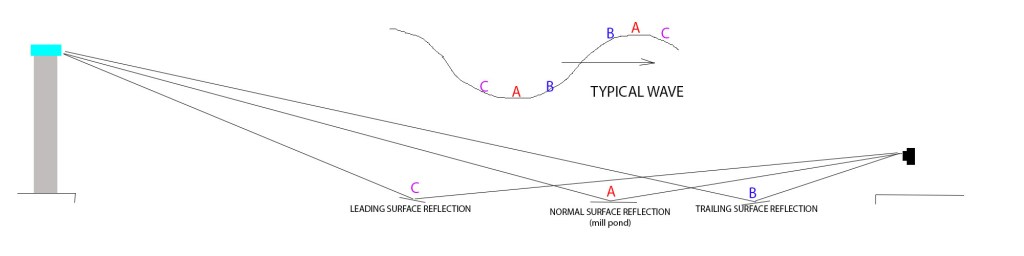
At the point where the wave is flat – at its peak and the bottom of the trough – you should see the normal reflection as if the surface was a mill pond. The leading surface of a wave will reflect light into the camera lens and the trailing surface will also reflect light into the camera lens and here is where the smearing occurs. What I think is happening is that the very bright lights – say the JP Morgan sign – overwhelm everything else above and below. So on the water surface beyond where the reflections of the letters would be for a dead calm surface we see reflections off the leading surface of the ripples. And conversely, closer to the camera we see reflections from the trailing surface of the ripples. Because the ripples/waves are marching across the water the reflections are merged together and the brightest light wins. If the ripples are going away from the camera then swap trailing surface for leading surface.
Curved Reflections – how they get their curve
So far so good, but what about the curve. That is explained by the fact that the ripples are not marching directly towards or away from the camera but are at an angle. Depending on the angle of the ripples (which way the wind is blowing) the reflection will appear to curve to the left or to the right. So in our case, if my theory is correct, the wind is blowing the waves in a direction that is from near left to far right or far right to near left. Which direction, forward or back, does not matter (just the orientation) but for the sake of this explanation I am assuming far right to near left.

In this case the rear edge/surface of the wave is acting as a mirror at an angle and reflects light that should be heading to the left of our camera back into our lens making it appear to come from somewhere to the left of where it should be. And by the same reasoning where we would expect to see a reflection on the right side of the band of light, the rear surface of the ripple reflects the light away from the lens making the water appear dark. If the ripples were orientated far left to near right the reflection would curve to the right.
 Mike Hawkridge Photography
Leave a comment